
Teen friendships

Not everyone needs to be cut off. Some people need the right distance.

Help teens separate loyalty from convenience, recognize unhealthy patterns, and match access to evidence.

New conflict guide

When should a teen repair, set a boundary, or step back?

Use a realistic decision framework to separate misunderstandings from repeated patterns and choose a next step the evidence supports.

Read the New Guide
Inside the article

More than “talk it out”

  • ClarificationFind out what is still unknown.
  • Repair and boundariesLook for accountability and changed behavior.
  • Distance and supportRespond appropriately when the pattern is harmful.
Educator guide

Friendship lessons should grow up with the students.

See what high-school lesson plans should teach about evidence, earned trust, boundaries, conflict, digital decisions, and private reflection.

Read the Guide
Inside the article

A complete lesson structure

  • Evidence over labelsAsk students to explain what changed their judgment.
  • Realistic choicesMove beyond “talk it out” as the only acceptable ending.
  • Protected privacyPractice serious decisions without forced disclosure.
Activity guide

Go deeper than icebreakers.

Use age-respectful discussion, sorting, scenario, and private-reflection activities to build evidence-based friendship judgment.

Read the Activity Guide
Inside the article

Eight practical formats

  • Evidence sortingSeparate observable facts, interpretations, patterns, and missing context.
  • Scenario decisionsChoose repair, boundaries, changed access, distance, or support.
  • Private reflectionTransfer the skill without requiring personal disclosure.
Boundary decision guide

Set the boundary—then evaluate what happens next.

Help teens move beyond automatic cutoffs. Use clarification, repair, changed access, distance, or stronger action based on the response and the pattern.

Read the Guide
Inside the article

Accurate next steps

  • Four possible outcomesClarification, repair, changed access, or distance.
  • Behavior-based repairWhy an apology opens the process but does not complete it.
  • Stronger-action signalsWhen repeated pressure, retaliation, or danger requires more.
Boundary guide

Friendship boundaries are clarity—not walls.

Help teens name emotional, conversational, digital, time, and access boundaries, say them in realistic language, and evaluate what a friend’s response reveals.

Read the Guide
Inside the article

What boundaries sound like

  • Five boundary typesIdentify exactly what needs protection or change.
  • A simple formulaName the situation, limit, and action the teen controls.
  • Response evidenceSeparate ordinary disappointment from repeated retaliation.
Parent and educator guide

Friendship worksheets should build better judgment—not just better manners.

Learn what effective teen friendship activities should teach about behavioral evidence, boundaries, accountability, conflict repair, and choosing the level of access a pattern supports.

Read the Worksheet Guide
What useful activities build

Thinking that transfers

  • Pattern recognitionSeparate facts, interpretations, single moments, and repeated behavior.
  • Boundary judgmentEvaluate both the boundary and the response it receives.
  • Proportionate decisionsChoose repair, changed access, distance, or appropriate support.
Practical guide

Healthy vs. unhealthy friendships are easier to name on a worksheet than inside real life.

Help teens look beyond labels and evaluate the patterns that matter: boundaries, privacy, accountability, competition, conflict, and what changes after an apology.

Read the Complete Guide
Inside the article

A practical evidence check

  • Healthy and unhealthy patternsA clear side-by-side comparison grounded in behavior.
  • Conflict versus a patternWhy one imperfect moment does not tell the whole story.
  • Access levelsOptions between inner-circle trust and a dramatic cutoff.
For educators

Begin with one focused question: What counts as evidence?

Our free grades 8-12 mini lesson helps students distinguish claims, single moments, patterns, and missing context before making a friendship judgment.
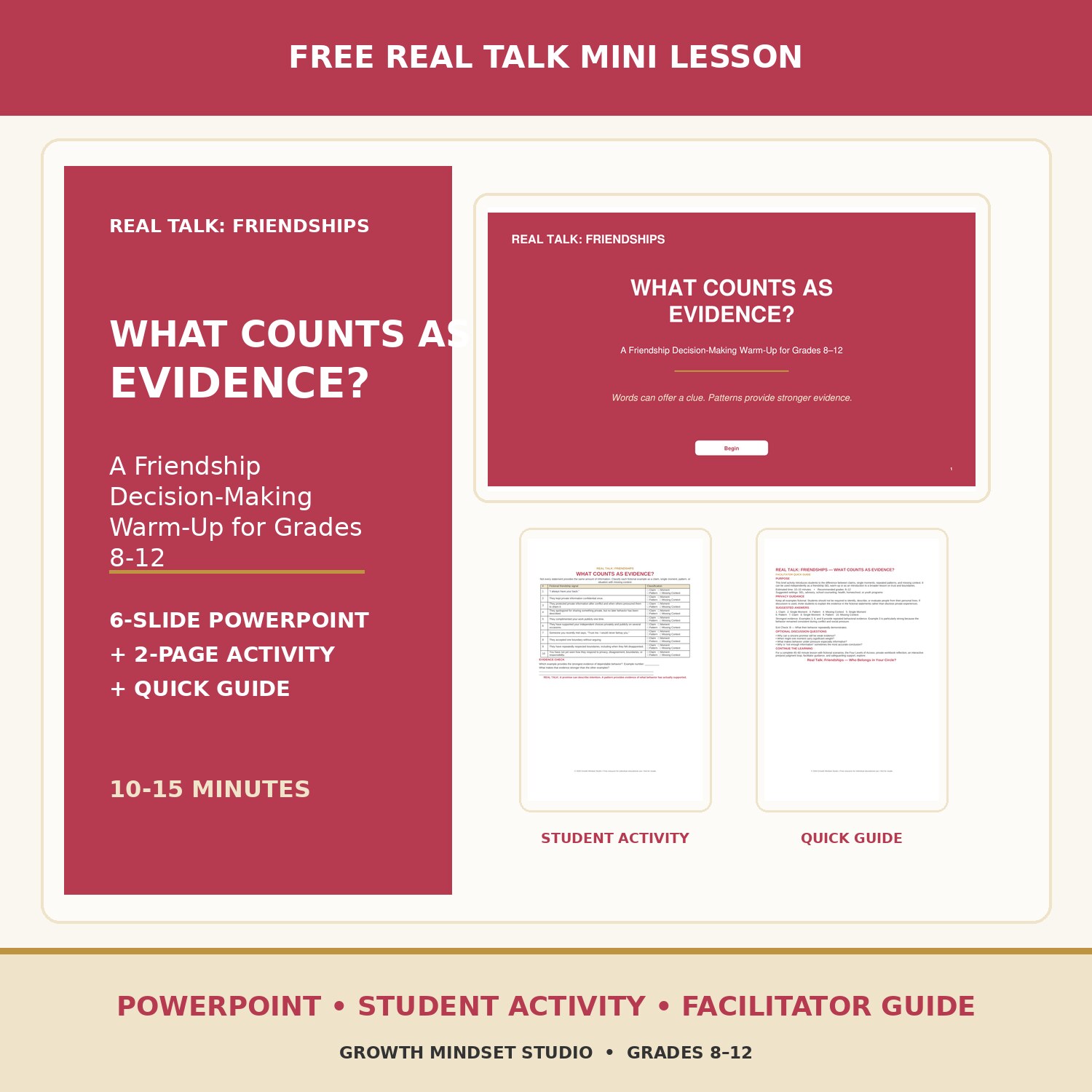
What Counts as Evidence free friendship SEL lesson
Free mini lesson

A 10-15 minute warm-up with everything included

Use the editable PowerPoint, two-page student activity, and facilitator quick guide in classroom, counseling, advisory, homeschool, or youth-program settings.

Loyalty guide

Proximity is not proof.

Shared classes, long history, mutual friends, and constant contact can make someone familiar without making them trustworthy. Use follow-through, privacy, boundaries, honesty, and repair to tell convenience from proven loyalty.

Featured workbook

Real Talk: Friendships — Stop Calling Everyone Close

A 140-page, reading-based workbook for ages 15-19 on loyalty, boundaries, access, reputation, and choosing who genuinely belongs in the inner circle.

View in the Etsy Shop →

Printable digital workbook available through our Etsy shop.
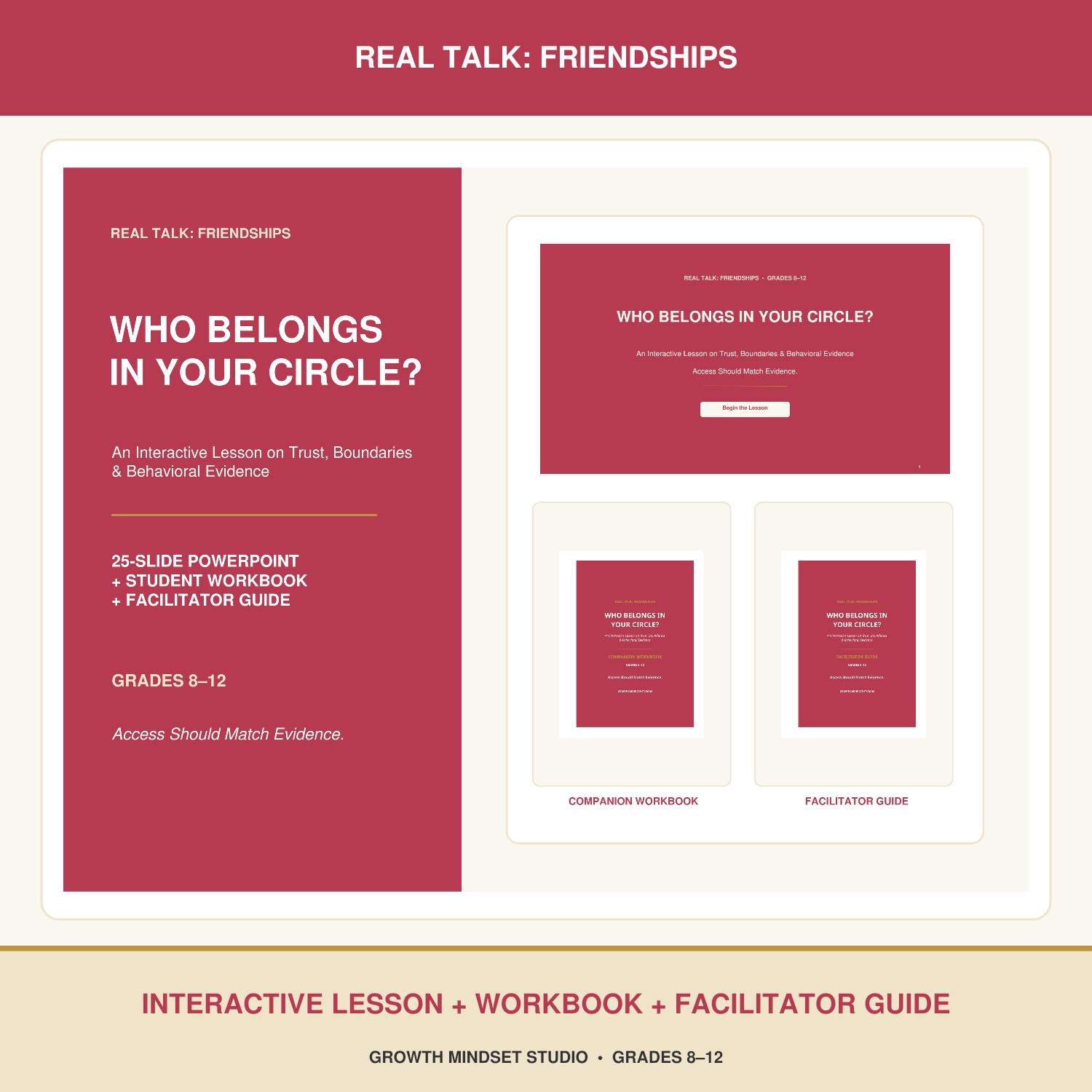
Complete classroom lesson

Move from recognizing evidence to deciding what access that evidence supports.

The full Who Belongs in Your Circle? lesson adds interactive scenarios, a companion workbook, pre/post reflection, and facilitator support for privacy and safeguarding.

View the Complete Lesson on TPT
Who Belongs in Your Circle complete friendship SEL lesson

Want both Real Talk reading workbooks?

Get the Relationships and Friendships volumes together in one coordinated printable bundle for teens ages 15-19.

View the Two-Workbook Bundle →